You open your phone to check your sleep score, your step count, your heart rate — and suddenly the app looks completely different. New icon, new name, new everything. Sound familiar? That’s exactly what millions of Fitbit users are waking up to right now, because the Google Health app has officially arrived, and it’s replacing the Fitbit app as we know it.
This isn’t just a coat of paint. Google has been quietly building toward this moment for years — ever since they acquired Fitbit back in 2021. And now, in 2026, the full vision is finally here. If you’ve been wondering what happened to your Fitbit app, or whether this new platform is actually worth your attention, you’re in exactly the right place.
Why Google Pulled the Trigger on This Rebrand
Let’s be honest: the Fitbit brand had been living on borrowed time. After Google completed the acquisition, it was only a matter of when — not if — the Fitbit identity would be absorbed into the Google ecosystem. The question everyone had was: would Google honour what made Fitbit special, or just bulldoze it?
Here’s the thing — they actually chose to build on it. The transition from Fitbit to Google Health isn’t about erasing a legacy. It’s about plugging a beloved wellness platform into something far more powerful. Google’s data infrastructure, its AI capabilities, its integration with Android and Wear OS — all of that is now working directly underneath your daily health tracking. That changes the game in ways most people haven’t fully appreciated yet.
And for users who’ve spent years building up their Fitbit history — their sleep data, their Active Zone Minutes, their personal records — none of that is gone. It travels with you into the new experience. That alone was a smart move from Google.
What the Google Health App Features Actually Look Like
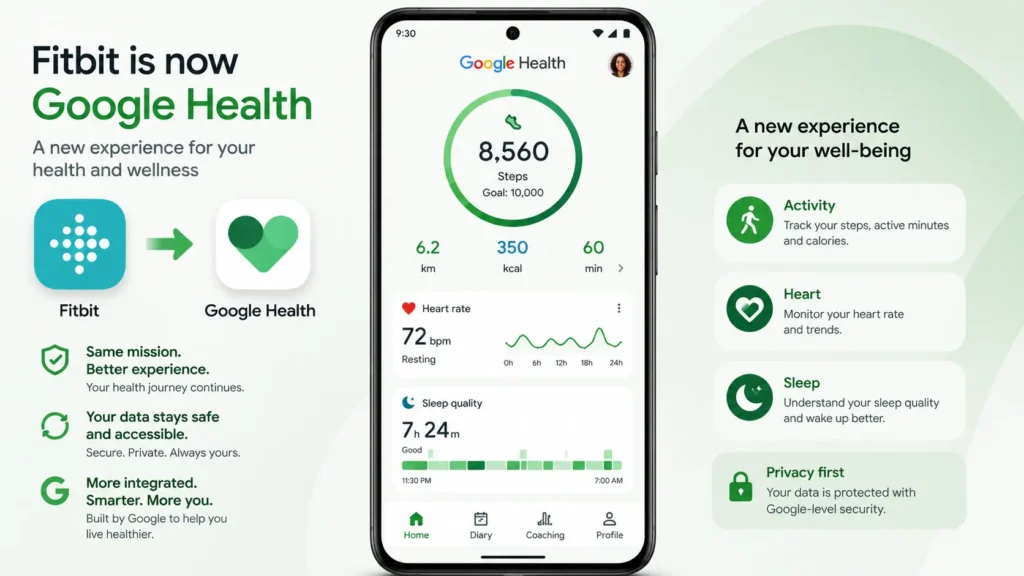
The new app isn’t just the old Fitbit with a fresh logo slapped on top. The Google Health app features a completely redesigned interface — cleaner, more visual, and built around a unified health dashboard that pulls everything into one place rather than making you jump between tabs.
The biggest upgrade? How the app connects dots between different health signals. Before, your sleep data lived in one corner and your activity stats lived in another. Now the app actively surfaces insights that link them — showing you, for example, how a particularly active Tuesday affected your deep sleep that night, or how your resting heart rate trends during high-stress weeks.
Google has also leaned heavily into AI-powered coaching. Instead of static weekly summaries that most people scroll past, the new experience delivers contextual nudges based on your actual patterns. It’s the kind of personalisation that feels genuinely useful rather than just technically impressive.
A few other things worth calling out:
- Deeper integration with Wear OS devices, including the Apple Watch-rivalling Pixel Watch lineup
- Improved menstrual health and cycle tracking with more granular symptom logging
- Expanded compatibility with third-party health apps and wearables
And the new logo? It’s a clean, minimal design that fits right into the Google product family. Gone is the old Fitbit icon — in comes something that feels like it belongs alongside Gmail, Maps and Chrome.
How to Switch From Fitbit App to Google Health App
If you’re sitting there wondering how to switch from Fitbit app to Google Health app — good news: for most users, it’s not really a switch at all. The transition is being handled automatically. When the update rolls out to your device, your existing Fitbit account data migrates into the new experience without you lifting a finger.
That said, there are a few things worth doing proactively. First, make sure your Fitbit app is fully updated before the migration triggers — this reduces the chance of any data hiccups during the changeover. Second, if you use a Fitbit Premium subscription, check your account status, because the billing and benefits structure has been updated under the Google Health umbrella.
For Android users, the experience is particularly seamless. The Google Health app plugs directly into your existing Google account, so your health data is treated with the same security framework as your Gmail or Drive. For iPhone users, the app is available on iOS too — though naturally, some features work more fluidly within the Android ecosystem.
One thing to keep in mind: if you’re a long-time Fitbit device owner wondering whether your tracker will still work — yes, existing Fitbit hardware remains fully supported. Your Charge, Sense, Versa or Inspire will continue to sync with the new app just as it did before. Google has been clear that device compatibility isn’t changing overnight.
Where This Is Actually Heading — And Why It Matters
Here’s what most coverage of this rebrand misses entirely: this isn’t just a consumer-facing redesign. It’s Google staking a serious claim in the digital health space at a moment when that space is becoming enormously competitive.
Apple‘s health ecosystem has been growing aggressively. Samsung Health continues to evolve. And the idea of a single, intelligent platform that knows your body well enough to give genuinely useful guidance — not just data — is the race everyone is running in 2026.
What makes Google’s position interesting is the AI layer. With the kind of machine learning infrastructure that Google operates, the potential for what is the new Google Health app replacing Fitbit to become is enormous. We’re talking about a platform that could eventually flag meaningful health changes before you even feel them — drawing on patterns across sleep, activity, heart rate variability and more.
Is it there yet? Not completely. But the foundation being laid right now is genuinely exciting. And for anyone who’s been using Fitbit for years and worrying this rebrand would water down something they loved — from what I’ve seen, this feels like an upgrade, not a downgrade. The soul of Fitbit’s approachable, everyday wellness tracking is still there. It’s just running on a much bigger engine now.
The question isn’t whether the Google Health app is worth trying. It’s whether you’re ready to take your wellness tracking seriously — because this platform is clearly ready to meet you there.
If you’ve already made the switch, drop a comment and tell me what you think of the new look. And if you’re still on the fence, bookmark this page — because as new features roll out over the coming months, I’ll be covering every update right here on The Apps Zone.

The Apps Zone is your go-to resource for discovering the best mobile apps across all categories. We provide expert reviews, tips, and recommendations to help you make the most of your smartphone or tablet. Whether you’re looking for productivity tools, entertainment options, or learning resources, we’ve got you covered!