Imagine spending weeks on a track, pouring everything into the mix, and then still not knowing if it’ll ever reach the right ears. That’s the reality for most independent artists in 2026 — incredible talent buried under the noise of an oversaturated market. Sound familiar?
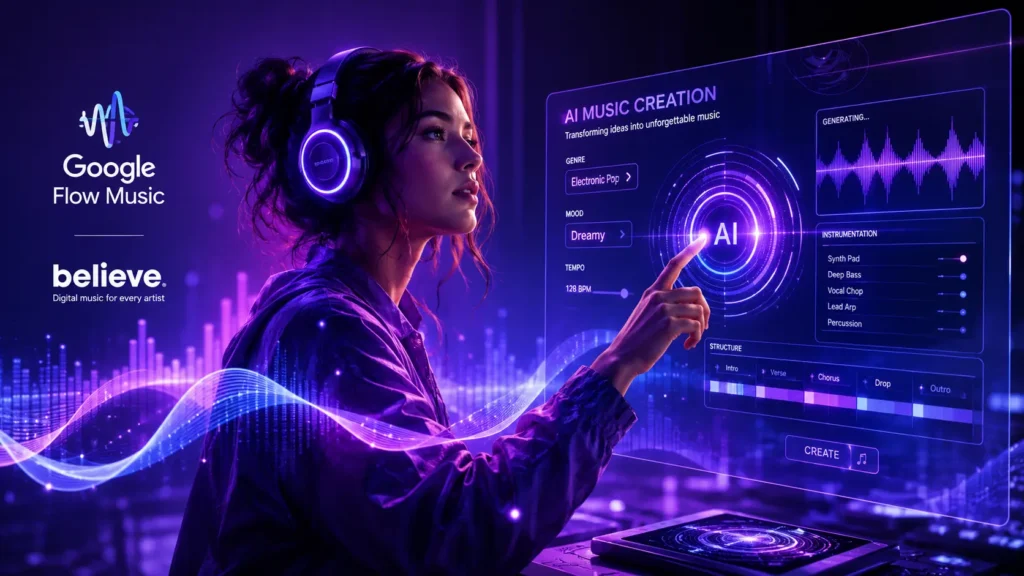
Here’s where things get interesting. Flow Music Believe artists tools is the collaboration no one saw coming — and yet, in hindsight, it makes total sense. Google‘s Flow Music platform and Believe, one of the world’s leading independent music distribution groups, are joining forces to bring next-generation AI tools directly to artists, producers and songwriters. Not to labels. Not to executives. To the creators themselves.
This isn’t just another tech announcement. It’s a genuine shift in who gets access to professional-grade music tools — and if you make music for a living (or dream of it), you need to understand exactly what’s on the table.
Why This Partnership Changes the Rules for Independent Artists
Let’s be honest: the music industry has always been built on gatekeeping. The best tools, the best distribution, the best insights — they went to artists who already had label backing. Everyone else was working with scraps.
The Google Flow Music and Believe partnership flips that script. Believe has built its reputation by championing independent artists globally, and Flow Music brings Google’s AI muscle into the creative process. Together, they’re targeting the gap that independent musicians know too well — the space between making something great and actually building a sustainable career from it.
And the timing matters. In 2026, AI-assisted music creation is no longer a novelty. Tools like Suno have already shown that AI can generate full tracks from scratch. But Flow Music isn’t about replacing artists — it’s about amplifying what they already do. That’s a fundamentally different and, honestly, more exciting proposition.
What Flow Music Actually Brings to Your Creative Process
So what does this look like in practice? Think of a producer working at midnight on a track that’s 90% there but missing something in the arrangement. Flow Music’s AI tools can analyse the structure, suggest harmonic variations, flag pacing issues — all without overwriting the producer’s creative intent.
For songwriters, the tools go even deeper. Lyrical suggestions, melody mapping, even mood analysis based on chord progressions. It’s the kind of feedback that used to require a well-connected A&R manager or a very patient collaborator. Now it’s available on demand.
And if you’ve ever explored what AI can do for music production, you’ll know we covered the broader landscape in our guide on how to produce original tracks with AI — but this partnership takes things to a completely different level because it connects creation directly to distribution infrastructure.
That connection is the real unlock here. Creating a great song is one thing. Getting it in front of the right audience, on the right platforms, with the right metadata and release strategy — that’s where most artists lose momentum. Flow Music and Believe are building a pipeline that handles both ends.
Believe’s Role: Distribution Meets Data Intelligence
Believe isn’t just a distribution platform — it’s a data-driven ecosystem. The company tracks streaming trends, audience behaviour and playlist performance across dozens of markets. When you combine that intelligence with Google Flow Music’s AI capabilities, artists get something genuinely rare: real-time creative feedback informed by real market data.
Here’s a practical example. You’re releasing a lo-fi hip-hop EP. Believe’s data might show that your target audience streams most actively on Thursday evenings, skews heavily toward listeners in Brazil and Indonesia, and responds better to tracks under three minutes. Flow Music can then help you shape your final mix and track sequencing with those insights in mind — before you even hit upload.
This kind of intelligence used to live exclusively inside major label A&R departments. Now it’s being democratised, and that’s worth paying attention to.
It’s also worth noting how this connects to the broader AI wave reshaping creative industries. We’ve seen Gemini features rolling out across Google TV and AI tools transforming everything from farming to content creation. Music was always going to be part of this shift — the question was who would lead it.
What Artists Should Actually Do Right Now
If you’re an independent artist, producer or songwriter reading this, the move is simple: get familiar with both platforms before the competition does. Early adopters in any tool ecosystem always have an edge — not because the tools do the work for them, but because they understand how to use them effectively before everyone else catches up.
A few things worth doing immediately:
- Check Believe’s artist portal for onboarding information related to the Flow Music integration — they’ve been rolling out access in waves.
- Explore what AI-assisted feedback looks like in your workflow by testing adjacent tools like ElevenLabs for voice and audio experimentation, so you’re already comfortable with AI-in-the-loop creativity.
- Document your current release process — knowing where your bottlenecks are will help you understand exactly where Flow Music’s tools will save you the most time.
The artists who thrive with these tools won’t be the ones who know the most about AI. They’ll be the ones who know themselves as creators — and use AI to remove the friction that’s been holding them back.
For anyone building a music brand or creative business around their art, pairing this with solid productivity tools matters too. A platform like Notion for managing your release calendar, or even exploring what free AI tools can do for your workflow, can turn a solo artist operation into something that runs like a small creative studio.
And if you’re thinking about sharing your music journey or building an audience while these tools are still fresh — platforms like TikTok and Instagram remain the fastest ways to build an organic fanbase around your creative process. Document the journey, not just the finished product.
The Bigger Picture: Who Really Benefits Here?
Let’s zoom out for a second. Google Flow Music and Believe aren’t doing this out of pure altruism — and that’s completely fine. Google expands its footprint in the creative AI space. Believe strengthens its value proposition to independent artists and grows its ecosystem. Both companies win when artists produce more, release more and earn more.
But here’s the thing: that alignment of incentives actually works in artists’ favour. When a platform’s growth depends on your success, the tools it builds for you tend to be genuinely useful — not just impressive demos.
The music industry has been waiting for a partnership that bridges the gap between AI creativity tools and real distribution infrastructure. Flow Music and Believe might just be the version that finally sticks. And if you’ve been sitting on the sidelines wondering whether AI tools are worth exploring for your music career — 2026 is the year to stop wondering.
Curious about how other AI tools are reshaping creative industries right now? We’ve been covering the wave closely — from AI image generators to the latest in smart tech. Stick around — this space moves fast, and we’ll make sure you don’t miss a thing.

The Apps Zone is your go-to resource for discovering the best mobile apps across all categories. We provide expert reviews, tips, and recommendations to help you make the most of your smartphone or tablet. Whether you’re looking for productivity tools, entertainment options, or learning resources, we’ve got you covered!