
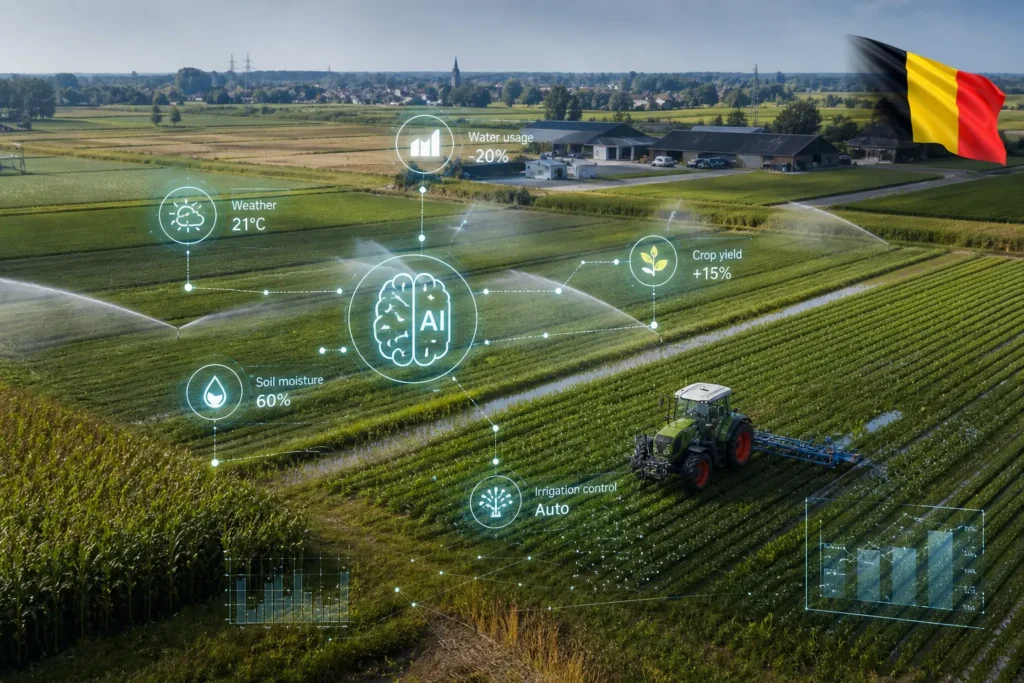
Picture this: it’s a dry Belgian summer, the kind that’s become uncomfortably familiar in 2026. A farmer outside Ghent watches the sky, checks the soil, and worries — not about prices or pests, but about water. There simply isn’t enough of it, and what’s there isn’t always safe to use. This is the quiet crisis that’s been building in Belgium’s Scheldt Basin for years.
And that’s exactly where the story of how AI helps farmers save water in Belgium gets genuinely exciting. Because the solution isn’t just better buckets or smarter sprinklers. It’s Google‘s artificial intelligence working alongside real agricultural experts — monitoring rivers, predicting contamination, and helping farmers make smarter decisions before a single drop is wasted.
The Scheldt Basin Problem Nobody Was Talking About
The Scheldt is one of Europe’s most important river networks, threading through Belgium and into the Netherlands before reaching the North Sea. It feeds farms, communities, and ecosystems across the region. But here’s the thing: it’s under enormous pressure. Agricultural runoff, industrial pollution, and shifting rainfall patterns have made water quality unpredictable and water availability genuinely scarce in critical growing periods.
Traditional water monitoring has always been reactive — you test the water, find a problem, and deal with the fallout. By then, crops may already be damaged or contaminated. Farmers lose money, food safety is compromised, and nobody wins. What was missing wasn’t effort — it was speed, scale, and predictive intelligence.
That gap is exactly what Google AI water quality monitoring in the Scheldt Basin is designed to close. Working with agricultural organisations Agua Segura and AgriFoodTech partners, Google brought its AI infrastructure to a problem that had been growing quietly for decades.
Where the AI Water Saving Farming Magic Actually Happens
Let’s be honest — when most people hear “AI for farmers,” they imagine something vaguely futuristic and completely disconnected from muddy boots and real fields. The reality is far more grounded, and far more impressive for it.
The system uses machine learning models trained on years of water quality data from the Scheldt Basin. These models analyse sensor readings, satellite imagery, weather forecasts, and historical contamination patterns simultaneously — something no human team could do fast enough to be useful. The result is an early-warning system that flags water quality risks before they become water quality disasters.
For a farmer deciding whether to irrigate, that means getting an alert that the nearby water source has elevated nitrate levels — before they pump it onto their crops. For a water management authority, it means knowing which stretches of river need immediate attention. This is AI tools doing exactly what they should: removing guesswork from decisions that really matter.
And the smart water management apps built around this system aren’t complex dashboards designed for data scientists. They’re built for farmers — accessible, clear, and actionable. You get a risk level, a recommendation, and the data behind it. No PhD required.
Google AI Agriculture: More Than a Tech PR Story
It would be easy to read this as a polished corporate sustainability initiative — Google ticking a green box somewhere on a report. But the ground-level impact on Google AI agriculture in Belgium tells a different story.
Reports suggest farmers in the pilot areas have been able to reduce water usage meaningfully by timing irrigation more precisely — using water only when the AI confirms quality is acceptable and soil conditions actually demand it. That’s not just good for the environment. It cuts operating costs in a period when energy and water prices have been climbing across Europe.
There’s also a food safety dimension here that tends to get overlooked. When farmers unknowingly irrigate with contaminated water, the consequences can reach supermarket shelves weeks later. AI for farmers that monitors contamination in real time creates a verifiable quality trail — something increasingly valuable in an era where consumers and regulators want full traceability.
It’s worth connecting this to the broader wave of AI productivity tools reshaping how professionals in every industry make decisions. Farming in 2026 isn’t exempt from that transformation — it’s increasingly at the centre of it.
What This Means for the Future of Smart Water Management Apps
Here’s what genuinely excites me about this initiative: it’s not a closed system. The framework being developed in Belgium’s Scheldt Basin is designed to scale. The same AI architecture that monitors one river basin can, in principle, be adapted for the Po Valley in Italy, the Rhine in Germany, or river systems across Southeast Asia where water stress is even more acute.
The best AI apps for sustainable farming and water management aren’t going to be single-purpose tools for a single country. They’re going to be intelligent platforms that learn from every basin, every farm, every season — getting sharper with every data point. Belgium is, in many ways, the proof of concept that the rest of the world is watching.
And if you’re curious about how AI is expanding into other areas of everyday life and infrastructure, the latest Gemini features rolling out to Google TV give you a sense of just how broadly Google is threading its AI capabilities into the world around us. The farm and the living room are, increasingly, part of the same connected ecosystem.
There are also interesting parallels in how AI is being used to support professionals in high-stakes environments — whether that’s AI apps helping teachers personalise learning or systems like this one helping farmers protect their water supply. The common thread is AI reducing the cost of being wrong.
Some of the core capabilities making this work include:
- Real-time sensor integration pulling water quality data from multiple points along the Scheldt simultaneously
- Predictive contamination modelling that forecasts risk windows days in advance based on weather and upstream activity
- Farmer-facing mobile alerts that translate complex data into plain, actionable guidance
The AI doesn’t replace the farmer’s knowledge. It amplifies it — giving them information at a speed and scale they could never access alone.
One thing worth flagging: while the results being reported from the Scheldt Basin initiative are genuinely promising, the full long-term impact on water conservation will take more seasons of data to properly quantify. This is an evolving project, not a finished product. And that’s actually fine — the best technology tends to improve in deployment, not just in the lab.
If you want to follow how AI is reshaping the tools we rely on daily, it’s worth keeping an eye on how apps for daily life are increasingly being powered by the same kind of intelligent infrastructure now being deployed in Belgian fields. The lines between consumer tech and industrial AI are blurring fast.
Why This Story Should Matter to Every Tech Fan
You might be reading this and thinking — interesting, but I live in a city and I don’t farm anything. Fair enough. But here’s the thing: every time AI water saving farming tools reduce crop losses and protect food quality upstream, you feel it at the supermarket. Water scarcity is a supply chain problem, and supply chain problems become your problem eventually.
Beyond that, the Scheldt Basin initiative is a compelling demonstration of what happens when serious AI infrastructure — the kind usually associated with search algorithms and recommendation engines — gets pointed at a real-world environmental crisis. It works. And that matters enormously as climate pressures on water systems intensify across Europe and beyond.
The other thing this story illustrates is that AI for farmers doesn’t have to mean replacing human expertise with robots. The most effective implementations augment what farmers already know with data they couldn’t otherwise access. That’s a model worth paying attention to, whether you’re in agriculture, education, healthcare or anywhere else.
For those curious about how AI is being used in grant funding to support exactly these kinds of sustainability projects, our breakdown of AI grant writing software is worth a read — because getting these initiatives funded is a story in itself.
Belgium’s farmers are dealing with a very real, very urgent problem. And right now, AI is helping them deal with it better than anything else available. That’s not a marketing story. That’s just what good technology looks like when it’s pointed in the right direction.
Keep following The Apps Zone — because stories like this one, where tech meets the real world in genuinely useful ways, are exactly what we’re here for. And there are a lot more of them coming.
Curtiu o conteúdo?
Faz parte da nossa comunidade! 💜
Não perde nenhuma novidade de tecnologia, IA e gadgets. Entra no grupo e se inscreve no canal!

The Apps Zone is your go-to resource for discovering the best mobile apps across all categories. We provide expert reviews, tips, and recommendations to help you make the most of your smartphone or tablet. Whether you’re looking for productivity tools, entertainment options, or learning resources, we’ve got you covered!