You open your laptop on a Monday morning and you’ve got leads sitting in one tool, follow-up emails scheduled in another, your sales pipeline in a spreadsheet, and your landing pages on yet another platform. Sound familiar? If you’re running a small business or a marketing agency in 2026, this is the kind of chaos that quietly eats your week — and your budget.
That’s exactly the problem Go High Level was built to solve. One platform. One login. CRM, email marketing, SMS automation, funnels, booking, reputation management — all of it under one roof. But “all-in-one” is one of the most abused phrases in SaaS, so the real question is: does this Go High Level review hold up when you actually use the thing?
I spent weeks digging into the platform, testing its automation workflows, comparing it against alternatives like HubSpot, and talking to agency owners who’ve been running their businesses on it. Here’s everything you need to know before making the call.
Methodology note: This review is based on hands-on testing of Go High Level’s Agency Starter and Agency Unlimited plans, public pricing and feature documentation as of mid-2026, and feedback gathered from agency owners and small business users. Competitor data comes from official product pages and verified user reviews.
Why Your Tool Stack Might Be Costing You More Than You Think
Here’s the thing most marketers don’t calculate until it’s too late: the real cost of running five separate tools isn’t just the monthly fees. It’s the time you spend switching between them, the data that gets lost in integrations, and the mental load of maintaining five different logins, five billing cycles, and five sets of updates.
A small business running a basic marketing setup in 2026 might be paying for a CRM, an email tool, a funnel builder, a booking app, and a reputation management service separately. Add those up and you’re easily looking at $300–$500 a month — before factoring in the hours spent on Zapier automations just to make them talk to each other.
That fragmentation is exactly where Go High Level positions itself. And for agencies managing multiple client accounts, the value proposition gets even sharper. But let’s not get ahead of ourselves — because consolidation only makes sense if the individual tools are actually good enough to replace your existing ones.
Go High Level Features: What’s Actually Inside
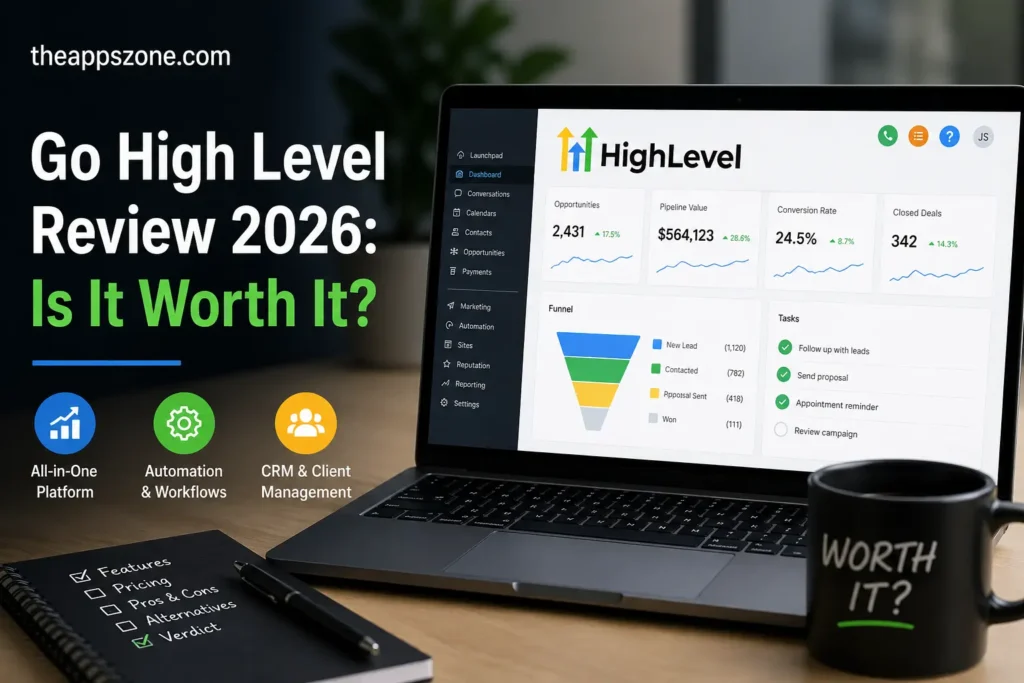
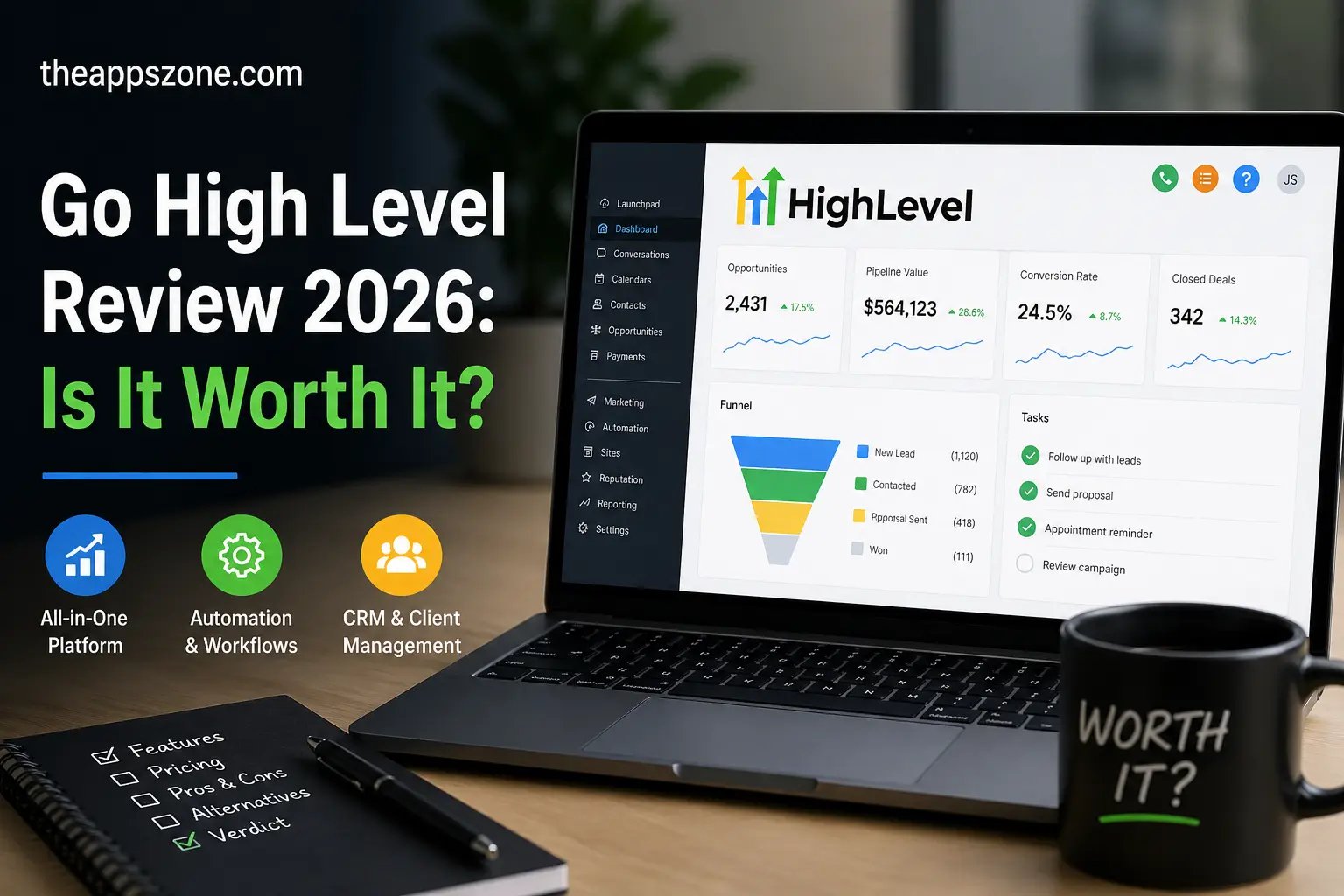
When you first log into Go High Level, the dashboard can feel overwhelming. There’s a lot going on. But once you understand the architecture, it starts to click.
The platform is built around a core CRM — contacts, pipelines, tags, custom fields — that feeds into everything else. From that same contact record, you can trigger an SMS sequence, add someone to an email nurture flow, book a call, send a review request, or launch a full funnel. That level of native integration is genuinely rare, and in practice, it means you spend way less time babysitting automations.
The automation builder is where things get really interesting. You can create multi-step workflows that combine email, SMS, voicemail drops, internal notifications, and even social DMs — all triggered by lead behavior. For a marketing automation software for small business context, this is the kind of capability that used to require an enterprise budget.
Go High Level features also include:
- White-label capability — agencies can rebrand the entire platform as their own product and resell it to clients
- Website and funnel builder — drag-and-drop, no coding needed, with decent template options
- Reputation management — automated review requests sent via SMS or email, with Google and Facebook integration
- Appointment scheduling — a built-in calendar system that replaces tools like Calendly for most use cases
The detalhe que pouca gente menciona is the two-way SMS functionality. Most platforms treat SMS as a broadcast channel. Go High Level lets contacts reply, and those replies land in a unified inbox — which means you can have actual conversations without leaving the platform. For local service businesses, that alone changes how leads get handled.
Go High Level CRM vs HubSpot: The Honest Comparison
This is probably the comparison you came here for. And I’ll be straight with you: the Go High Level vs HubSpot marketing automation comparison doesn’t have a clean winner — it has a clear answer for each type of business.
HubSpot’s CRM is objectively more polished. The reporting is deeper, the UI is more intuitive for beginners, and the ecosystem of integrations is massive. If you’re a growing B2B company with a sales team that lives inside a CRM all day, HubSpot’s workflow tools and deal management will feel more mature. And to be fair, HubSpot’s free tier is genuinely useful — something Go High Level doesn’t offer.
But here’s where the math flips: as soon as you need HubSpot’s automation features beyond the basics, you’re looking at the Marketing Hub Professional tier, which starts at around $800/month in 2026. That’s not a typo. For small businesses and agencies, that number is simply out of reach.
Go High Level’s Agency Unlimited plan — which lets you run unlimited client accounts — sits at $297/month. When you factor in that it replaces your funnel builder, booking tool, reputation manager, email platform, and SMS tool, the per-feature cost comparison isn’t even close for most agency and SMB use cases.
Where HubSpot genuinely wins: enterprise-level analytics, native LinkedIn integration, and a more established partner ecosystem. If your business scales to the point where those things matter, it might be time to revisit the decision. But for most small businesses and agencies reading this in 2026, that’s a future problem.
| Platform | Best For | Standout Strength | Key Limitation |
|---|---|---|---|
| Go High Level | Agencies, local businesses, SMBs | All-in-one + white-label + SMS automation | Steeper learning curve, no free tier |
| HubSpot | B2B sales teams, larger companies | Polished UI, deep reporting, free CRM | Expensive at scale, separate tool costs add up |
| ActiveCampaign | Email-first marketers, e-commerce | Best-in-class email automation logic | No funnel builder, no native booking |
| Keap (Infusionsoft) | Small business with complex pipelines | Strong pipeline automation | Dated UI, high learning curve |
The Real Talk: What Go High Level Gets Wrong
Any review that only tells you the good stuff should make you suspicious. So let’s talk about the friction points — because there are real ones.
The onboarding experience is rough. There’s a lot to configure before the platform starts feeling useful, and the documentation, while improving, still has gaps. Most users report spending 2–4 weeks before they feel genuinely comfortable navigating it. If you’re expecting to plug it in and go live in a weekend, adjust those expectations.
The funnel and website builder is functional but not best-in-class. If you’re a designer who cares deeply about pixel-perfect layouts, you’ll hit limitations. It’s good enough for most lead generation use cases — but it’s not going to replace a dedicated tool like Webflow for complex builds.
Email deliverability is another area to watch. Like any platform that handles bulk sending, your results will depend heavily on how well your domain is warmed up and your list is maintained. Go High Level gives you the tools to do it right, but it doesn’t hand-hold you through the process. You need to know what you’re doing — or be willing to learn.
And the mobile app? It exists, and it works for managing conversations and checking pipelines on the go. But it’s not as polished as the desktop experience. For a marketing automation platform in 2026, that’s a gap worth noting.
Which Type of Business Actually Gets the Most Out of This?
Let me be direct about who this platform is built for — and who it’s probably not the best fit for.
Go High Level makes the most sense if you’re running a marketing agency managing multiple client accounts. The white-label reseller model is genuinely powerful: you can brand the entire platform as your own, charge clients a SaaS fee, and build a recurring revenue stream on top of what you’re already doing for them. That business model alone is why so many agencies have migrated to it over the past few years.
It also works really well for local service businesses — think dentists, real estate agents, gyms, home service companies — that need lead capture, follow-up automation, appointment booking, and review management all talking to each other. The platform was essentially designed around this use case, and it shows.
If you’re a solo e-commerce brand focused purely on email sequences and product launch funnels, you might find that a more specialized email tool gives you better results for less complexity. And if you’re a large B2B company with a dedicated sales ops team that needs deep CRM customization and enterprise reporting, HubSpot or Salesforce will serve you better — even at the higher price.
Is Go High Level worth it for small business? Honestly, yes — with one caveat. You need to be willing to invest time in learning it, or bring in someone who already knows the platform. The ROI is real, but it’s not instant.
If you want to explore it yourself, you can try Go High Level here — they offer a trial period so you can poke around before committing.
Final Verdict: Should You Make the Switch?
Here’s where I land after spending real time with this platform: Go High Level is one of the most complete marketing automation platforms available for agencies and small businesses in 2026 — but it earns that title through breadth, not polish.
If you’re currently juggling multiple tools, paying for things that barely integrate with each other, and spending time on admin instead of actual marketing, the consolidation case is strong. The automation capabilities, the Go High Level CRM, the native SMS and booking features — when they work together, they genuinely change how a business operates day-to-day.
It’s not perfect. The learning curve is real, the funnel builder has limits, and you’ll need patience during setup. But for the right user — especially agency owners and local business operators — the value per dollar is hard to beat at this price point.
If you want to explore whether it’s the right fit for your setup, check out Go High Level and start your trial here. Take the time to actually build something in it — that’s when the platform clicks, and honestly, that’s when you’ll know for sure.

The Apps Zone is your go-to resource for discovering the best mobile apps across all categories. We provide expert reviews, tips, and recommendations to help you make the most of your smartphone or tablet. Whether you’re looking for productivity tools, entertainment options, or learning resources, we’ve got you covered!